Introduction: Capturing Insight Through B2B Webinars
Webinar lead generation today has become a structured demand system that captures and targets interest, ICP qualification, and buying intent tracking. Webinars create a controlled environment where education, engagement, and evaluation occur within a single motion.
Webinars provide a platform to engage the right stakeholders, offering deeper insights into buyer behavior while driving scalable lead generation. When operationalized correctly, webinar marketing becomes a measurable ROI-driven demand-gen engine; that leverages pipeline intelligence rather than just attendance metrics.
The Shift: From Webinar Marketing to Intent Infrastructure
Traditional webinar marketing focused on registrations, attendance rates, and post-event follow-ups. While these metrics indicate reach, they fail to capture why prospects attended, what they evaluated, and how close they are to a buying decision.
Modern webinar lead generation requires a shift toward intent-driven design:
- Who is attending and from which target accounts?
- What content sections drive engagement metrics?
- Which questions indicate solution readiness or buying authority?
- How does behavior during the session correlate with solution-specific interest?
TSL ensures that webinars are not executed as campaigns, but as structured demand accelerators engineered to track engagement intelligence and identify interest.
4 Bottlenecks in Conventional Webinar Lead Generation
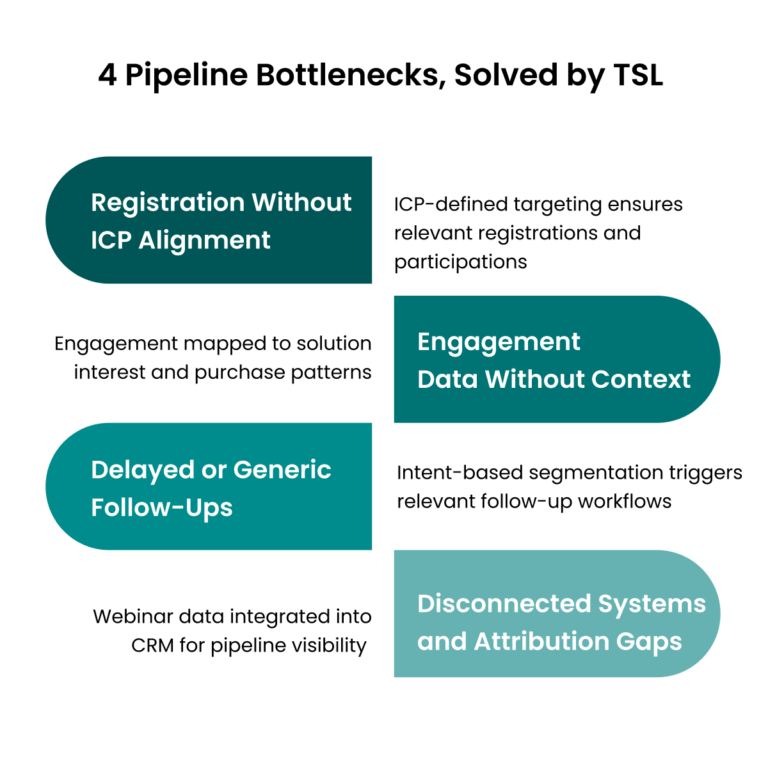
Despite high engagement signals, many B2B teams struggle to convert webinars as an effective platform for MQL generation. Four systemic gaps that slow results:
1. Registration Without ICP Alignment
Open registrations drive volume but attract mixed-fit audiences, resulting in low-quality leads.
We define ICP, account tiers, and role targeting to ensure registrations align with high-fit buyer profiles.
2. Engagement Data Without Context
Webinar interactions are often tracked in isolation, limiting their value.
We map engagement to solution-specific interest and purchase history and patterns to generate predictive intent insights.
3. Delayed or Generic Follow-Ups
Manual follow-ups can be slow and script-driven, can dilute the prior engagement impact.
We automate intent-based segmentation, relevance-driven follow-up workflows.
4. Disconnected Systems and Attribution Gaps
Siloed webinar platforms break data continuity and limit pipeline impact.
We integrate webinar data into CRM and demand systems for end-to-end pipeline and revenue visibility.
The TSL Framework: Engineering Webinar Lead Generation
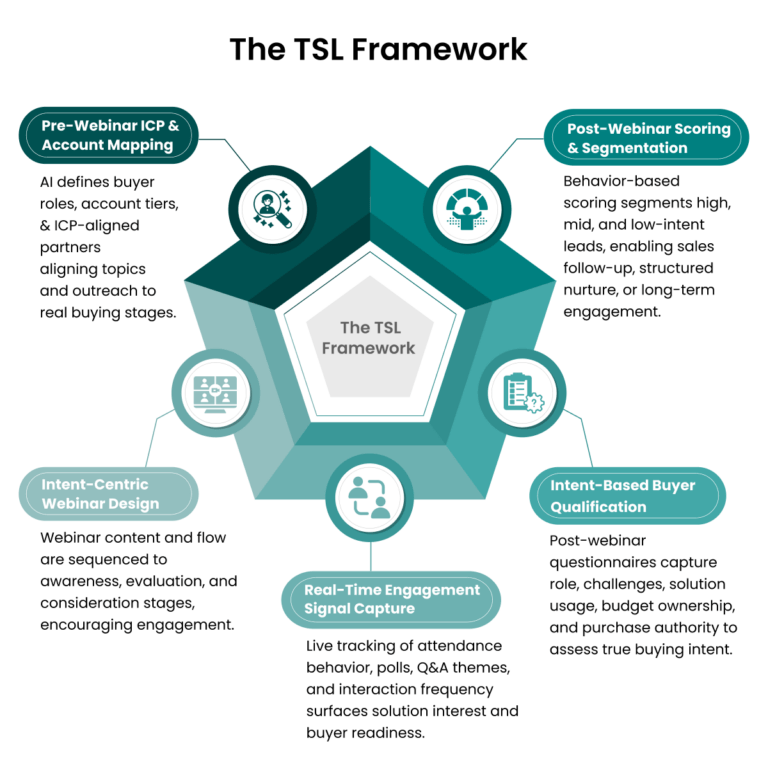
1. Pre-Webinar ICP & Account Mapping
Before registrations open, we define:
- AI-informed ICPs across industries, account tiers, and key decision-makers
- Webinar topics aligned to buyer stage
AI-driven email outreach is used to:
- To communicate the core solution-driven takeaways
- Personalize emails conveys the relevance such virtual events
This ensures webinar outreach is well targeted, not just driving a broad audience.
2. Intent-Centric Webinar Design
Every webinar is designed to surface interest signals using a user-friendly webinar platform that encourages participation. The topic sequencing is aligned to awareness → evaluation → consideration.
3. Real-Time Signal Capture & Enrichment
During the session, we track:
- Dwell metrics, including attendance at session start vs. session end
- Poll responses analyzed for solution relevance
- Q&A participation and question themes mapped to buyer roles
- Interaction frequency across polls, downloads, and form fills
4. Intent-Based Buyer Qualification Metrics
After the webinar, we use crisp, structured questionnaires to understand an attendee’s solution interest. These capture:
- The attendee’s role and influence in the decision-making process
- Whether they are already using the product or a similar solution
- Current challenges and business priorities
- Scope of tech-refresh or upgrade
- Budget responsibility and purchasing authority
5. Post-Webinar Scoring & Segmentation
Rather than treating all attendees equally, we apply behavior-based scoring:
- Low-intent or research-stage leads retained for long-cycle engagement
- Mid-intent leads placed into structured nurture and progression tracks
- High-intent leads routed for sales qualification
This transforms webinars into a predictable engine for b2b lead generation.
Webinar Marketing as a Demand Enablement Strategy
Effective webinar lead generation bridges marketing and sales by delivering context-rich intelligence instead of raw contacts. When webinars are structured around intent, they provide sales teams with clear top-of-the-line visibility.
We enable this by converting webinar engagement into actionable insights, including:
- Engagement summaries highlighting topics viewed, questions asked, and interaction depth
- Account-level visibility across multiple attendees to surface collective buying intent
Hence, sales teams engage with confidence, knowing exactly what buyers explored, evaluated, and prioritized during the session.
Integrating Webinar Lead Generation into the Demand Stack
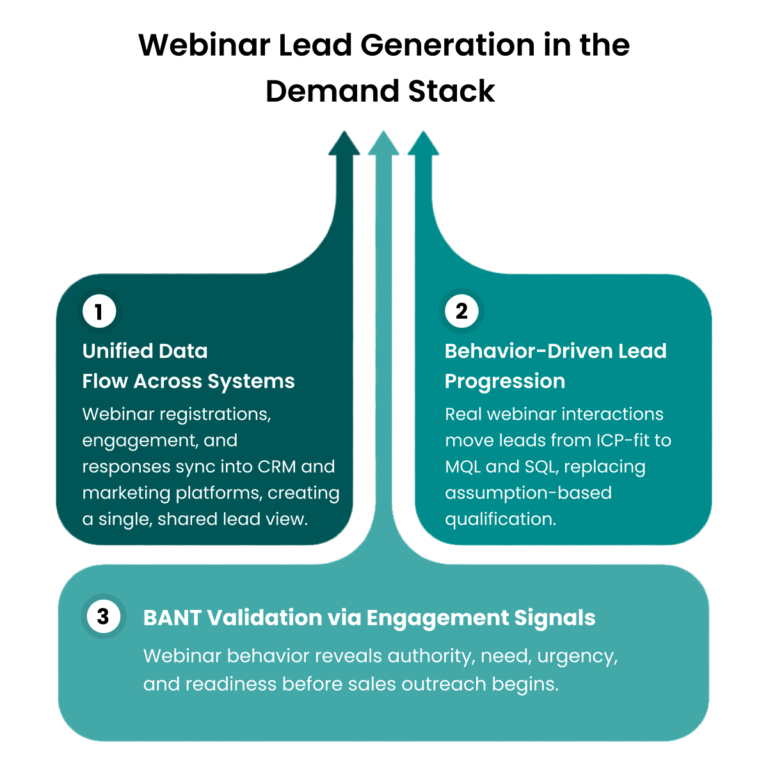
- Unified data flow across systems: Webinar registrations, attendance, engagement, polls, and questions are automatically synchronized with CRM and marketing automation platforms, giving marketing and sales a single, consistent view of every lead.
- Behavior-driven lead progression:
Webinar engagement is used to move leads through defined stages (ICP-fit Lead → MQL → SQL) based on actual interaction, removing guesswork from qualification. - BANT validation through engagement signals:
Buyer behavior during webinars helps indicate authority, need, urgency, and readiness, supporting more accurate BANT qualification before sales outreach begins.
TSL’s Blueprint for Turning Webinars into a Demand Engine
Webinar is no longer an optional B2B marketing tactic; they are now an integral method for demand infrastructure, especially in tech spaces. When engineered with structured design, real-time intent capture, and system-level integration, webinar marketing becomes a repeatable, measurable, and scalable engine for B2B growth.
From ICP-driven targeting and intent-centric engagement design to qualification workflows, TSL helps you engineer webinars for intent, intelligence, and impact.
Make every webinar count with TSL. Talk to us today.
📞 +91 9529286060 | 📧 smohite@tslmarketing.com
FAQs
Webinar lead generation is the process of capturing, qualifying, and nurturing leads through webinars. For B2B tech companies, it provides a structured environment to engage prospects, understand buying readiness, and generate high-quality leads that feed pipeline and revenue outcomes.
Unlike traditional webinar marketing that focuses on registration and attendance metrics, TSL treats webinars as structured demand environments. This approach captures intent signals, buyer engagement, and readiness, enabling actionable insights for sales and marketing teams.
Four major challenges often hinder results:
- Registrations without alignment to ideal customer profiles (ICP)
- Engagement data without context or actionable insights
- Delayed or generic follow-ups that reduce lead value
- Disconnected systems that obscure pipeline impact
We capture real-time signals such as poll responses, questions, attendance duration, and interaction frequency. These signals are enriched with account-level data to create detailed lead profiles, enabling targeted follow-ups and accurate lead scoring.
We ensure webinar data flows seamlessly into CRM and marketing automation platforms. Leads are progressed through defined stages (Lead → MQL → SQL) based on engagement, and participation is directly linked to pipeline, BANT qualification, and revenue reporting.
Webinars deliver high-quality participation, extended engagement, built-in qualification, and scalable education for complex solutions. When engineered correctly, they provide measurable insights, enabling predictable pipeline outcomes and more confident sales engagement.