

Introduction
Selling enterprise software solutions like ERP, CRM, SaaS platforms, and cloud infrastructure is rarely about volume. It is usually about credibility and risk.
When deal sizes involve significant implementation budgets, conversations quickly move beyond features. Integration risk, business disruption, change management, and ROI justification become central concerns. A wrong decision can cost far more than the software license itself.
Enterprise buying journeys are layered and careful. Multiple stakeholders review integration feasibility, data security, compliance exposure, and financial impact before moving forward. Even after months of discussion, a deal can stall if one key decision-maker is not fully convinced.
This is where structured lead generation services become critical. The goal is not just generating interest but building buying confidence.
With higher ticket sizes, misalignment becomes expensive. It affects forecasting accuracy, sales morale, and quarterly visibility. Precision and domain familiarity often determine whether conversations move forward or remain stuck in evaluation.
Consultative Selling Built for Complex Buying Committees
Because enterprise software solutions’ decisions carry significant risk, TSL Consulting builds its lead generation services around consultative selling rather than transactional outreach.
In higher ticket ERP and SaaS sales, prospects rarely reject solutions immediately. More often, they pause. Concerns surface around migration risk, internal disruption, user adoption, or budget reprioritization. Without early discovery around these friction points, deals can extend across quarters.
Instead of leading with product features, conversations are structured around identifying system gaps, reporting limitations, workflow inefficiencies, and modernization priorities.
Within enterprise ERP, SaaS, and cloud engagements, the approach typically includes:
- Business-first discovery conversations that uncover operational bottlenecks
- Role-based stakeholder engagement aligned to technical, financial, and operational decision factors
- Positioning solutions around practical use cases such as faster order cycles, improved data management, scalable cloud environments, or reduced manual reconciliation
This structure strengthens qualification depth before opportunities are passed forward.
Mapping Ideal Customer Profiles and Decision Structures
Enterprise lead generation services perform better when account selection is intentional.
We combine structured ICP research with AI-assisted account intelligence to analyse industry segments, revenue bands, technology environments, and growth signals. This helps identify organizations that show stronger alignment with the solution profile rather than relying only on surface-level filters.
Within each organization, buying groups are mapped carefully. AI-supported data enrichment helps uncover decision-makers, reporting lines, and functional influence patterns. We identify who initiates evaluation, who validates architecture, who influences financial approval, and who signs off on procurement.
Many enterprise deals slow down not because interest is missing, but because outreach reached only one stakeholder. IT may see technical merit, while finance questions cost impact. Operations may worry about process disruption. When the full decision group is not engaged early, sales cycles become longer and less predictable.
Clear mapping, supported by data intelligence, brings relevance and stability to enterprise outreach.
Capturing Solution-Specific Intent Signals
Engagement does not always mean buying readiness.
Our lead generation services incorporate AI-driven intent monitoring to distinguish early research from active evaluation. Instead of treating every interaction equally, engagement patterns are analysed for buying depth and timing.
In enterprise environments, some organizations explore ERP upgrades or cloud migration strategies for extended periods before allocating budget. AI models help identify behavioural shifts such as repeated solution-page visits, pricing research, competitor comparisons, and cross-stakeholder engagement, which may indicate stronger purchase intent.
Signals monitored include:
- ERP migration or cloud transformation content engagement
- Demo and pricing inquiries
- Webinar participation and solution brief downloads
- Competitive comparison research
By aligning outreach timing with intent indicators and behavioural scoring, we prioritize higher-probability accounts while nurturing early-stage prospects appropriately.
Educating Buyers to Support Internal Justification
Enterprise software decisions often require internal alignment across departments.
Stakeholders may need clarity around deployment effort, integration pathways, reporting impact, and cost implications before moving forward.
Through collaborative webinars and structured discussions aligned with OEM sales teams, we support buyers in building internal confidence. Rather than pushing urgency, the focus remains on enabling informed progression through practical, business-aligned conversations.
From Qualification to BANT-Validated Opportunities
Higher-value software engagements require careful qualification.
Premature handovers can weaken credibility. When sales teams enter conversations without clarity on budget ownership, authority, or timeline, trust can erode quickly.
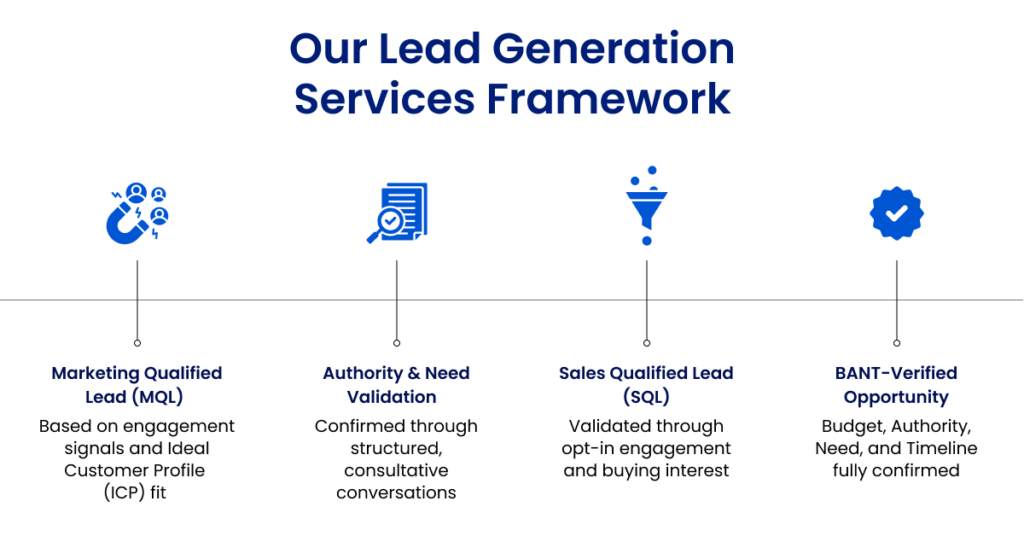
Our lead generation services follow a structured progression:
- Marketing Qualified Lead based on engagement and ICP fit
- Authority and Need validation through consultative conversations
- Sales Qualified Lead confirmed through opt-in engagement
- BANT verification covering budget, authority, need, and timeline
This layered validation helps ensure that opportunities entering the pipeline carry real buying context.
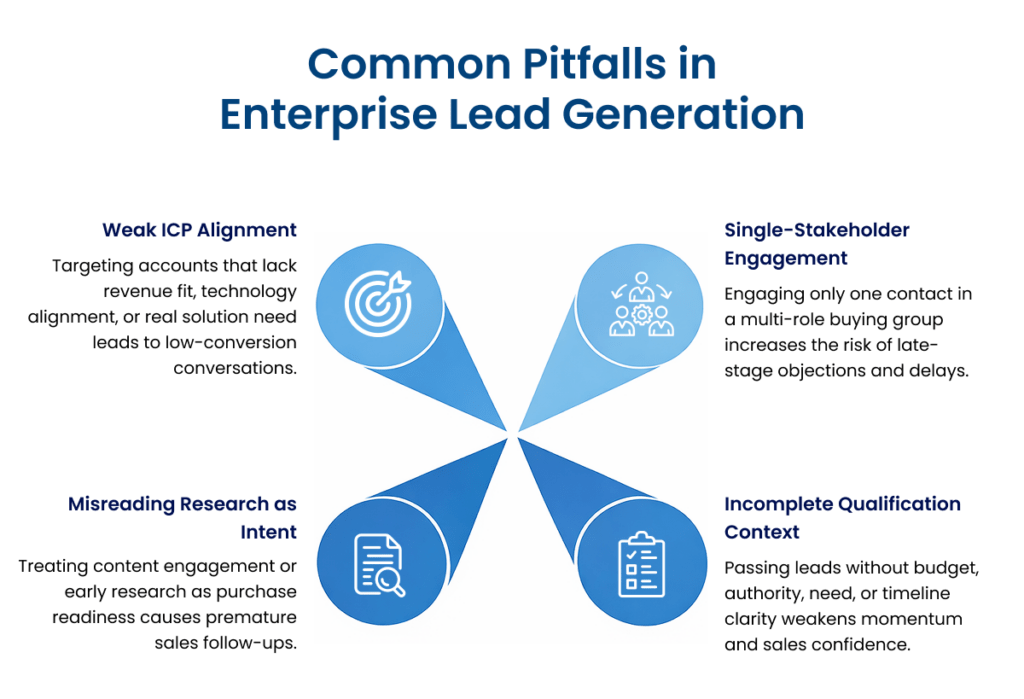
Common Pitfalls in Enterprise Lead Generation and How We Address Them
Enterprise demand often exists, yet pipeline movement slows when outreach does not reflect how enterprise buying works.
Common challenges include:
- Targeting accounts without strong ICP alignment
- Engaging only one stakeholder in multi-role buying groups
- Treating research activity as buying readiness
- Passing leads without sufficient business context
Our focus remains on structured engagement built on account fit, stakeholder mapping, intent signals, and disciplined qualification rather than volume-driven outreach.
This shift results in fewer stalled opportunities and clearer prioritization for sales teams.
Why Enterprise Software Providers Choose TSL
Enterprise technology providers choose TSL Consulting for the balance between domain experience and structured execution.
With over two decades of enterprise IT exposure, we understand the pressure that longer sales cycles and higher ticket sizes create. Our lead generation services are designed to support ERP, SaaS, and cloud providers navigating complex buying environments.
The outcome is not just more conversations, but conversations built on context, clarity, and commercial alignment.
Conclusion
Enterprise-grade selling carries unique pressure. Sales cycles are longer. Budgets are larger. Internal alignment takes time. Risk sensitivity shapes every discussion.
Generic outreach may create activity, but complex ERP, SaaS, and cloud environments benefit from credibility from the first interaction.
Structured lead generation services help enterprise solution providers engage aligned accounts, surface genuine buying signals, and move opportunities forward with confidence.
In high-ticket enterprise sales, momentum grows when trust and qualification move together.
Connect with the experts at TSL to turn enterprise complexity into qualified pipeline and predictable revenue.
📞 +91 9529286060 | 📧 smohite@tslmarketing.com
FAQs
Enterprise software sales involve long cycles, multiple stakeholders, and higher risk. Structured lead generation services build credibility, align buying groups, and improve qualification accuracy before pipeline entry.
Enterprise buying involves layered decision-making across IT, finance, and operations, with a focus on integration risk, ROI justification, compliance exposure, and internal alignment before approval.
AI-driven intent monitoring distinguishes research from active evaluation by analyzing engagement patterns like pricing inquiries, competitor comparisons, webinar participation, and repeated solution-page visits.
TSL builds consultative, business-first conversations, maps buying committees, validates BANT criteria, and ensures opportunities carry real commercial context before sales handover.
Enterprise providers choose TSL for domain expertise, structured ICP research; AI-assisted intelligence, stakeholder mapping, and disciplined qualification aligned to complex ERP and SaaS sales cycles.
TSL prevents stalled deals through precise ICP targeting, multi-stakeholder engagement, intent-based prioritization, and layered validation from MQL to BANT-qualified opportunity progression.