
Why Landing Page Optimization Is Critical for B2B Growth
Most B2B marketing teams invest heavily in driving traffic. Budgets go into paid campaigns, SEO, content syndication, and outbound outreach, only for high-intent visitors to land on pages that fail to convert effectively. Often, this is not a traffic problem. It is a conversion and pipeline efficiency problem.
Landing page optimization is where marketing investments either generate stronger returns or lose momentum. In B2B environments, where sales cycles often extend from 3 to 9 months, even a modest improvement in conversion rates can create measurable revenue impact. Improving a landing page conversion rate from 2% to 4% does not simply increase leads. It can potentially double qualified pipeline without increasing acquisition spend.
Industry benchmarks suggest average conversion rates hover around 2–3%, while top-performing campaigns achieve conversion rates exceeding 5%. The gap between average and high-performing landing experiences often represents substantial pipeline potential generated from the same campaigns, traffic sources, and budget already in place.
For B2B organizations focused on improving pipeline efficiency and maximizing marketing ROI, landing page optimization is not a one-time activity. It is an ongoing strategy that strengthens engagement, improves conversion performance, and supports long-term revenue growth.
Understanding B2B Buyer Intent and Decision Complexity
B2B purchases rarely involve a single decision-maker. A typical buying committee includes 6 to 10 stakeholders, each approaching the evaluation from a different angle. Your VP of Sales is thinking about pipeline velocity. Your IT lead is thinking about integration risk. Your CFO is thinking about payback period. A landing page that speaks to all of them with the same message will likely resonate with none of them.
This is why matching your page to buyer intent matters more than matching it to your campaign objective.
Rather than thinking in rigid funnel stages, think about what question the buyer is actually trying to answer when they land on your page:
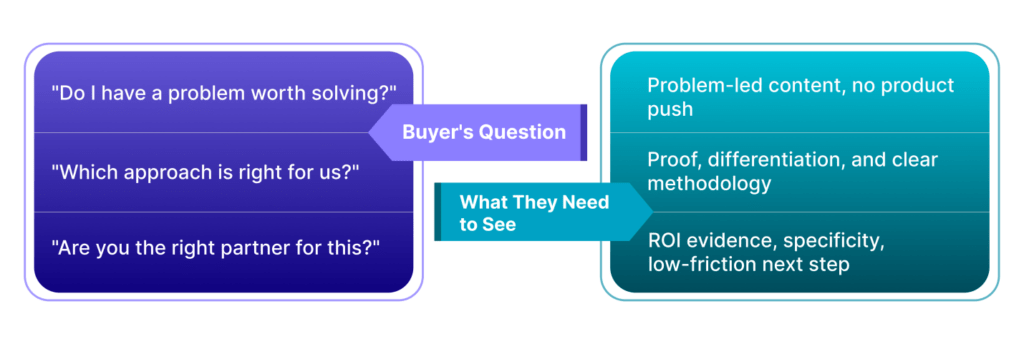
One page trying to answer all three questions at once tends to answer none of them convincingly. Dedicated pages built around single buyer intent consistently outperform generic campaign pages on both conversion rate and lead quality.
Crafting a Clear Outcome-Driven Value Proposition
Most B2B landing pages lead with what the product does rather than what the buyer gains. Phrases like “the leading platform for enterprise teams” or “an end-to-end solution for modern businesses” have become so familiar that they no longer register. Buyers skim past them instinctively.
The stronger approach is to lead with the outcome the buyer is already trying to achieve. Not what your solution does, but what their environment looks like after they have adopted it.
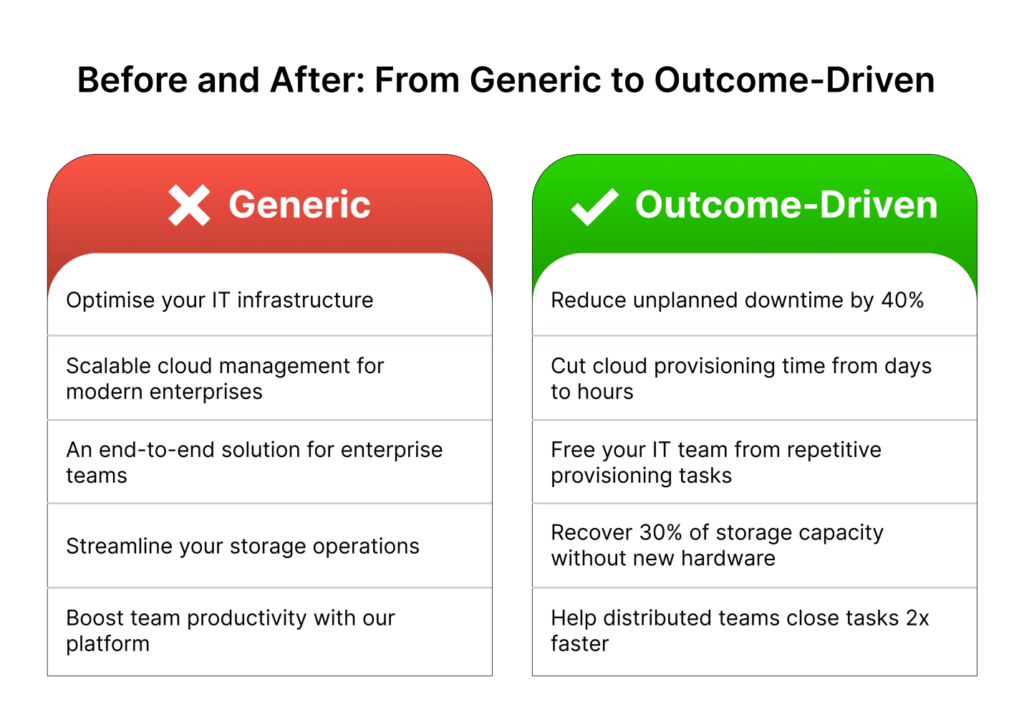
The difference is not about being clever or creative. It is about speaking the language your buyer uses internally when they are making the case for this investment. Specific, operational outcomes travel further inside a buying committee than polished product descriptions.
A well-crafted value proposition for landing page optimization does three things quietly and effectively:
- It reflects the buyer’s language back to them, using the words they use when describing the problem internally
- It makes the outcome feel specific and attainable rather than aspirational and vague
- It removes the need for the buyer to mentally translate your offer into something relevant to their situation
The headline is where this work matters most. Everything else on the page, the supporting copy, the proof points, and the CTA, exists to reinforce the promise made in the first line. If the headline is generic, good design and social proof further down the page can only do so much to recover the conversion.
For B2B landing page design specifically, clarity will always outperform cleverness. A buyer evaluating a six-figure purchase decision does not need to be charmed. They need to feel immediately confident that they are in the right place.
Structuring a High-Converting Landing Page
The best landing pages in B2B are not necessarily the most visually elaborate ones. They are the ones that answer the buyer’s next logical question at every scroll point, removing doubt and reducing friction until the only natural next step is to convert.
The structure that consistently works follows a clear and deliberate order:
Headline and Sub-headline
Your headline carries the primary outcome. It should be the single most important thing your buyer needs to hear at that moment. The subheadline adds the specificity that makes it credible. “Increase Qualified Pipeline” is a headline. “Built for B2B sales teams running account-based campaigns targeting enterprise accounts” is a subheadline. Together they do the work of orienting the buyer instantly.
Supporting Copy
Keep paragraphs short — three sentences or fewer. Use bullets to break down proof points rather than burying them in dense paragraphs. Every line should earn its place on the page. If a sentence does not move the buyer closer to a decision, it is adding friction rather than removing it.
Trust Elements
Client logos, analyst ratings, case study pull quotes, and security certifications all reduce perceived risk. The placement matters as much as the content. Position trust elements close to your CTA rather than at the bottom of the page where most buyers will never scroll to see them.
CTA Placement and Copy
Repeat your CTA at least twice — above the fold and after your social proof section. The button copy itself deserves as much attention as the headline. Outcome-specific CTAs consistently outperform generic ones. “Get My Free Audit” outperforms “Submit” not because it is creative but because it tells the buyer exactly what they are getting.
TSL's Conversion Architecture Approach
Before writing a single line of copy, TSL conducts a conversion architecture audit on every landing page we work on. We map the page layout to the buyer’s cognitive journey, identifying where questions arise, where doubt enters, and where the path to conversion becomes unnecessarily complicated. Structure first, copy second, design third.
Optimizing Forms without Sacrificing Lead Quality
Shorter forms increase submissions. But in B2B, submissions without context waste SDR time and distort pipeline reporting. The goal is not volume. It is qualified volume.
Three approaches tend to work well in practice:
Field Reduction Only ask for what sales actually needs in the first conversation. Name, email, company, and one qualifying question is usually sufficient. Every additional field is a small but real reason to abandon the form.
Progressive Profiling Rather than front-loading the relationship with a long form, collect additional information incrementally across multiple touchpoints. Buyers feel less pressured and lead profiles become richer over time without the friction of a lengthy upfront ask.
Multi-Step Forms Breaking a form into two steps, where the first captures basic contact details and the second captures qualifying information, reduces psychological resistance. Most buyers who complete step one will complete step two.
TSL’s Approach to Form Optimization TSL implements progressive profiling through marketing automation platforms, ensuring that landing page optimization never comes at the cost of lead intelligence. Submission volume is a starting point, not a success metric. For us What matters is how many of those leads are genuinely ready for a sales conversation.
Designing for Conversion and Credibility
Landing page design decisions have a more direct impact on conversion rates than most B2B teams realise. Layout, speed, and visual hierarchy are not aesthetic choices. They are functional ones that either support or undermine the buyer’s confidence at a critical moment.
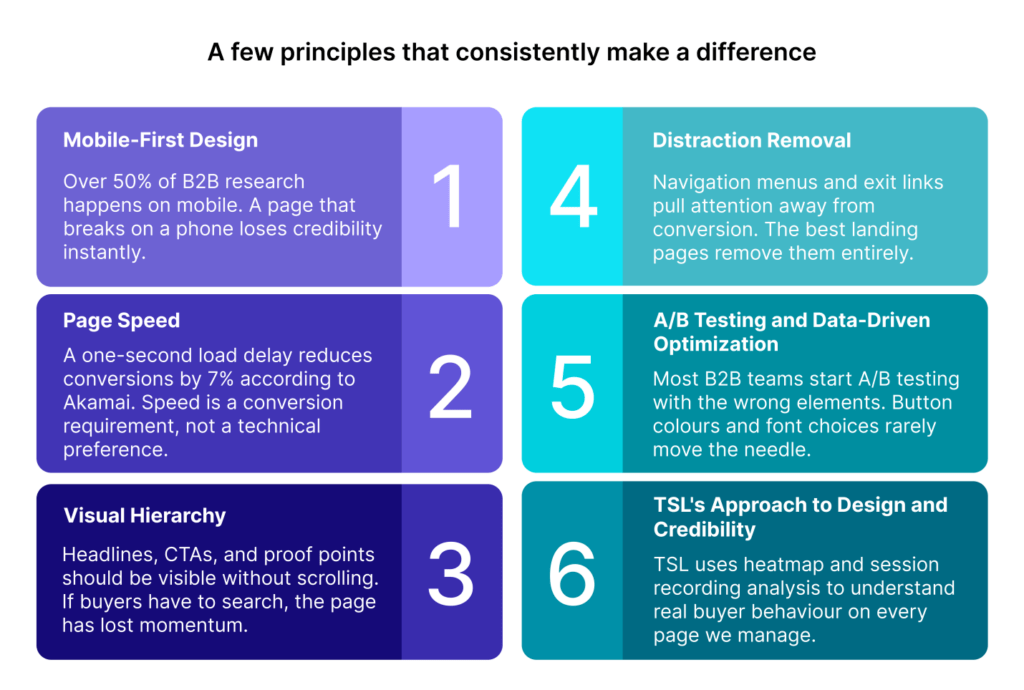
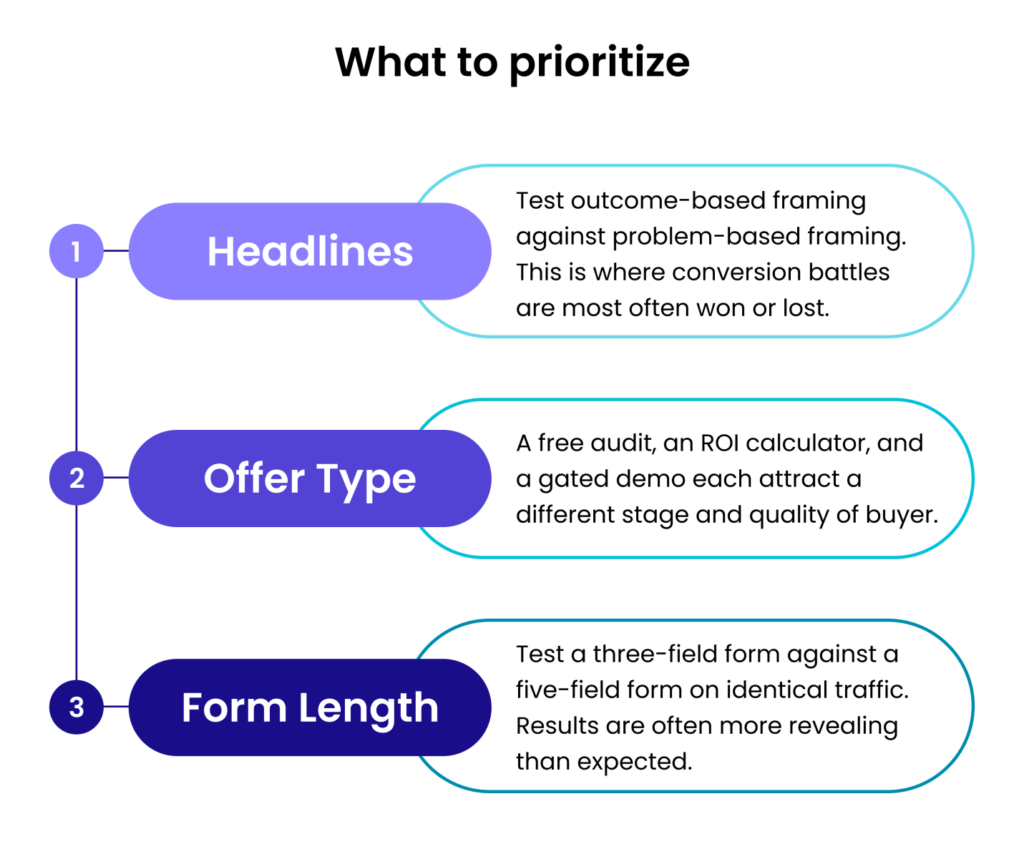
How to test well: A structured hypothesis makes the difference between a test that teaches you something and one that just produces a number. Before running any test, define what you are changing, what outcome you expect, which audience segment it applies to, and what success looks like numerically. “Changing the headline to focus on operational outcomes will increase form submissions by 15% among retargeting traffic” is a testable hypothesis. “Let us try a new headline” is not.
The metrics worth tracking in B2B go beyond form submissions. MQL volume, MQL-to-SQL conversion rate, cost per qualified opportunity, and pipeline influenced per page are the numbers that connect landing page performance to revenue outcomes.
TSL’s Approach to A/B Testing Our approach to landing page optimization is built around continuity. Every test is documented, every result analyzed, and every insight feeds the next iteration. Over time this builds an institutional knowledge base about what works for your specific audience, offer, and market segment.
How TSL Turns Landing Pages into a Scalable Pipeline Engine
A well-optimized landing page is only as valuable as the system behind it. What happens after the form submission determines whether your pages generate pipeline or simply generate data.
SDR Follow-Up Timing Studies show that leads contacted within 5 minutes of a form submission are up to 9 times more likely to convert than those contacted later. The same research indicates a significant drop in qualification odds when response time stretches from 5 to 30 minutes. Your landing page is only as effective as the follow-up process connected to it.
Continuous Optimization Loops A monthly cadence for reviewing conversion rate data, MQL quality scores, and pipeline contribution separates teams that improve consistently from those that optimize once and move on.
TSL’s Full-Funnel Approach TSL builds integrated pipeline systems that connect landing page design, SDR sequencing, and performance reporting into one cohesive engine. Our clients get a repeatable process for compounding pipeline growth, with every element working in concert rather than in isolation.
From Optimization to Pipeline Compounding
Landing page optimization is one of those disciplines that rewards consistency more than brilliance. A single well-structured test rarely transforms a programme. But a structured approach, applied consistently across pages, offers, and audience segments, compounds meaningfully over time.
The B2B teams that treat their landing pages as living assets rather than campaign deliverables tend to pull ahead gradually and then significantly. Every test adds context. Every iteration adds confidence. Every improvement in conversion rate multiplies the value of every campaign that follows.
The goal is not a perfect landing page. It is a system that keeps getting better.
If you are looking to build that kind of system, TSL would be glad to help you get started.
Connect with our experts today. 📞 +91 9529286060 | 📧 smohite@tslmarketing.com
B2B landing page conversion rates vary by offer type and traffic source. Demo request pages typically convert between 3% and 8%, while content download pages can convert between 10% and 25%. The more useful benchmark is not the industry average but how your page performs against its own previous version. Consistent incremental improvement compounds more meaningfully than chasing a fixed target.
Low-traffic B2B pages require longer test windows to reach statistical significance. Running tests for at least 30 days or 200 conversions per variant, whichever comes first, is a sensible starting point. Focus testing effort on high-impact elements like headlines and CTAs rather than design details. Bayesian testing models can help extract directional insights from smaller sample sizes without waiting for full statistical confidence.
The most damaging mistakes tend to be structural rather than cosmetic. Keeping navigation menus on the page, using generic outcome-free headlines, burying social proof below the fold, and sending all campaign traffic to a single page regardless of intent level are the issues that cost the most pipeline. Auditing pages across all three buyer intent stages is a reliable way to surface these issues before they affect results.
Progressive profiling allows you to collect buyer information incrementally across multiple touchpoints rather than asking for everything upfront. It improves form completion rates while building a richer lead profile over time. For B2B teams managing long sales cycles, this approach means sales conversations start with better context and less time spent on basic qualification questions that could have been answered earlier.
Form submission volume is a starting point, not a success metric. The numbers that matter are MQL volume, MQL-to-SQL conversion rate, cost per qualified opportunity, and pipeline influenced per page. Tracking these metrics consistently over time, rather than in isolation after a single test, is what connects landing page performance to real revenue outcomes and makes the case for continued investment in optimization.