

Imagine all your digital and nurture campaigns targeting a CIO, only to realize that the final decision depends on others in the organization. It could depend on a financial leader, a technical architect, and an operations manager or all of them together. This is the new reality of navigating B2B purchases in enterprise accounts. In tech spaces, solutions are evaluated collectively by buying groups and not individuals.
Enterprise technology investments are now showing more complex buying behaviours. The purchase functions are relying on cross-functional teams to evaluate potential solutions. Technical experts assess feasibility; finance teams evaluate costs, and business leaders’ measure strategic value.
B2B marketing success now depends on engaging the entire buying committees that influence the final decision.
The End of the Single-Buyer Era
B2B marketing strategies may have revolved around influencing a single decision maker within an organization. Campaigns were designed to target roles such as CIOs, CTOs, or procurement heads who were assumed to control purchasing decisions, but that seems to be changing soon. McKinsey’s B2B Pulse data states that B2B customers now extensively use 10 or more channels to interact with suppliers.
Today, enterprise buying decisions rarely follow that model. Technology investments now impact multiple teams and functions across the organization.
Forrester’s State of Business Buying, 2026 report reveals that the typical B2B purchase now involves 13 internal stakeholders and nine external influencers — and for more complex or strategic purchases, that number rises further. Notably, 94% of buyers in groups of six or more report clear benefits including broader validation, easier budget approval, and a higher likelihood of final sign-off.
Why is this shift happening?
- ERP, IoT platforms, CRM tools, and cloud apps need to validate technology choices together, not in silos.
- Larger technology investments, with bigger price tags, look closely at total cost of ownership and long‑term ROI
- Core functions like data strategy, operations, sales, and customer experience are all impacted, pulling in a wide range of stakeholders into the conversation.
Key Stakeholders of a Modern B2B Buying Group
Decisions around complex B2B purchases are evaluated by a group of stakeholders. Their priorities might be different, but their collective inputs determine whether a new/upgraded solution is feasible.
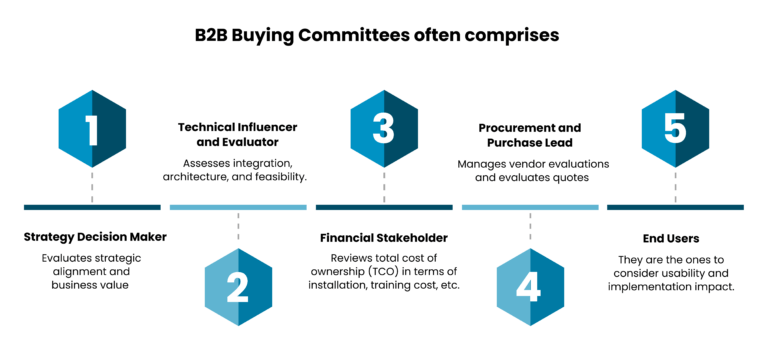
Beyond the above, there are additional stakeholders who can significantly influence the B2B purchase decision process. IT Security and Compliance teams often play a crucial role in validating security and regulatory standards. Even Department Heads and Business Unit Leaders may evaluate relevance of solution implementation to team-level objectives.
Strategies to Engage Buying Groups Effectively
Account-centric campaigns may show better engagement results as compared to broader-based campaigns. This is further validated by a 2025 Gartner survey of 632 B2B buyers, which found that 74% of buying teams experience unhealthy conflict during the decision process. However, buying groups that reach consensus are 2.5 times more likely to describe their final decision as high-quality, making stakeholder alignment a critical success factor and not just a nice-to-have.
TSL has spearheaded ABM-centric campaigns for several tech OEMs and partners. While strategizing multi-channel campaigns for our technology-driven customers, we’ve mapped ICP-aligned accounts and key stakeholders for executing targeted ads. Running coordinated multi-persona campaigns within the same account is what consistently delivers the strongest results.
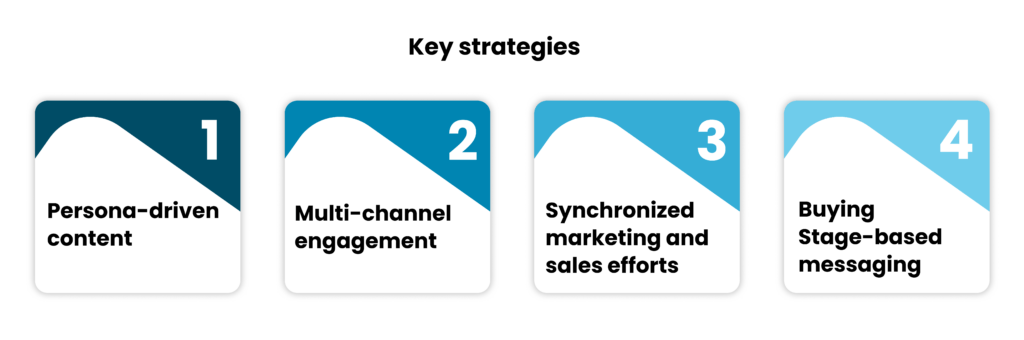
This approach has not only helped us tap new business accounts in broader geographies but even helped in remarketing missed accounts with context-aware messaging.
Identifying Buying Groups with Precision
Identifying the right stakeholders within a target account often remains unclear. In B2B purchases, market intelligence may indicate which accounts to focus on, but identifying who is part of the decision-making process is often a challenge.
Buying group signals may be indirect. It can show up through scattered interactions such as content engagement, repeated visits, or multiple personas from the same account engaging at different stages. Isolated evaluation of these signals may not reveal actionable intelligence.
With AI-led intelligence, we gain visibility into social media engagement, forum and event interactions and email engagement. These insights are further analyzed alongside purchase data to understand solution-specific interest and buying patterns. Identifying key-influencers, decision-makers and stakeholders becomes simpler as a part of the top-of-the-funnel evaluation process.
How TSL Maps the Right Accounts and Stakeholders
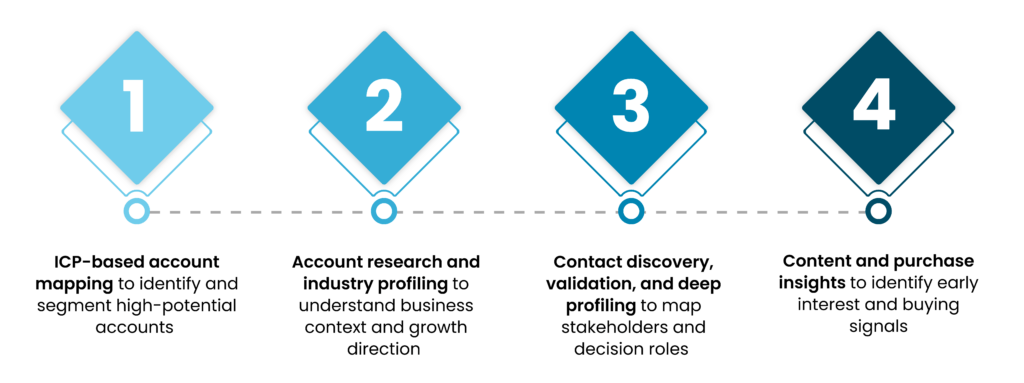
We start by identifying account clusters that are aligned with our client’s Ideal Customer Profile. The segmentation is not just about firmographic filtering but based on industry context and solution interest.
After defining the accounts, we execute contact deep profiling building depth within them. It’s not just identifying key stakeholders across functions but also about understanding their roles in the decision-making process. This is how our deep profiling methods move beyond service-level data.
The process is further strengthened by layering early-stage signals. Content engagement across blogs, emails and other digital platforms are evaluated along with past purchases and vendor associations giving visibility on purchase drivers and solution interest.
Turning Buying Group Insights into Revenue Outcomes
Understanding B2B buying groups is only one part of the equation. Taking timely actions on real-time intelligence is what TSL specializes in. Account mapping, intent signals and stakeholder engagement insights are brought to one common platform to track opportunities that are already in motion within the spectrum of B2B purchases.
The AI-driven lead intelligence helps surface high-intent accounts early, which is layered with structured nurturing across TOFU and MOFU stages. With seasoned consultative inside sales subject-matter experts, we validate interest and qualify BANT parameters.
TSL has delivered tangible business outcomes for its tech-driven clients, for more than 20 years. We strive to build stronger pipeline quality with shorter sales cycles and more predictable results.
Buying Group Intelligence in Action: Campaign Snapshot
A recent campaign was executed for a globally recognized leader in cloud-based HR and workforce management solutions. TSL mapped buying groups across three stakeholder layers including HR decision-makers, IT influencers, and HR operations managers/process owners for payroll, learning, talent acquisition etc. across enterprise accounts in India.
The results spoke for themselves:
- Manufacturing led all verticals with a ~70% lead acceptance rate (66 accepted from 93 worked)
- Pharmaceutical Manufacturing followed at ~57% acceptance, reinforcing the value of industry-specific, persona-led outreach
Overall, 57% of leads were accepted across 226 accounts worked, with nearly 30% still in active facilitation.
Disciplined stakeholder mapping combined with use-case-led messaging tailored to each persona’s priorities drove these outcomes. The engagement earned TSL repeat business and an expanded scope, a direct reflection of the client’s confidence in our buying group intelligence methodology.
Moving from Insight to Action with TSL
In tracking a complex B2B buying process, the challenge is rarely a lack of data. The real gap lies in connecting the right intent signals at the right time and knowing precisely when and how to engage each member of the buying group before your competition does.
If your team is struggling to surface the right influencers, decision-makers, and stakeholders within target accounts, we should talk. Whether you are refining your B2B buying group strategies or starting from scratch, TSL has the methodology and experience to accelerate your business outcomes.
Let’s get your buying group strategy working harder for you.
Connect with our experts today. 📞 +91 9529286060 | 📧 smohite@tslmarketing.com
A B2B buying group is a cross-functional team of stakeholders who collectively evaluate and approve enterprise purchase decisions. It includes decision-makers, technical evaluators, financial stakeholders, procurement leads, and end users. Engaging the entire group rather than a single contact directly determines pipeline quality and deal closure likelihood.
Enterprise solutions like ERP, CRM, and cloud platforms impact multiple functions across an organisation. Their increasing complexity and investment size means no single person can own the entire purchase decision, making cross-functional buying groups the new standard in enterprise B2B purchasing.
It starts with ICP-aligned account mapping and contact deep profiling across functions. Intent signals such as content engagement, repeated website visits, and multiple personas from the same account engaging at different funnel stages are layered together to surface the right stakeholders early.
Persona-driven content, multi-channel engagement and buying stage-based messaging work best. A 2025 Gartner survey found that buying groups reaching consensus are 2.5 times more likely to rate their final decision as high-quality, making coordinated multi-persona campaigns a critical engagement strategy.
AI-led intelligence surfaces visibility into social media engagement, forum interactions, email activity, and purchase history. These signals are analysed together to identify high-intent accounts, map key decision-makers early, and enable purposeful, persona-specific outreach across the entire buying committee.
Forrester’s 2024 data shows that 41% of B2B buyers already have a preferred vendor in mind before formal evaluation begins. Engaging buying group members at the top of the funnel, before vendor preferences are set, gives sales teams a decisive head start.
TSL maps buying groups through ICP-based account mapping, contact deep profiling, and layered intent signals. This intelligence activates coordinated multi-persona campaigns and consultative inside sales outreach across TOFU and MOFU stages. Every engagement is validated against BANT parameters, ensuring the right stakeholder are reached with the right message at the right time.