
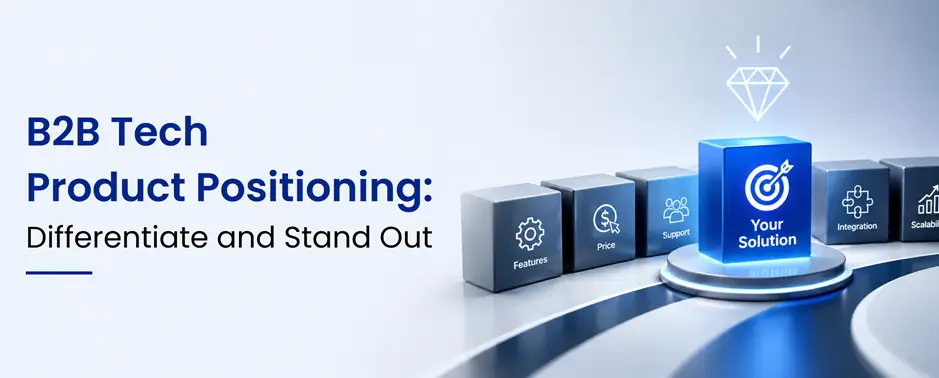
A better product does not always make for a more differentiated brand.
A technology company can have stronger capabilities, better performance, deeper expertise, or a genuinely different approach, yet still sound remarkably similar to the companies it competes with. The problem often isn’t what the business has built. It is how that value is understood.
B2B tech product positioning helps bridge that gap by defining what makes a technology product different, why that difference matters, and who it matters to. Without that clarity, even a strong product can struggle to earn attention or preference.
That is the positioning problem.
Solving it takes more than a sharper tagline. It requires clarity in what the brand stands for, how that value is communicated, and how consistently it is expressed across every customer touchpoint.
Product Differentiation Isn't Brand Differentiation
A technology product can be genuinely different. It may be faster, smarter, easier to integrate, or simply better suited to a particular customer need. But that does not automatically make the brand stand out.
The difference lies in how that value is presented and understood.
A product tells customers what you offer. Positioning helps them understand why it matters and why they should consider you over the alternatives.
That means a technology brand does not need to communicate everything its product can do. It needs to identify the strengths that matter most to its audience and build a clear story around them.
That is where product differentiation becomes brand differentiation.
Decide What You Want to Be Known For
A B2B technology company can have a powerful platform, multiple use cases, integrations across enterprise systems, and years of technical expertise. The challenge is that none of those, on their own, tell the market what the brand should be remembered for.
A company may describe itself through its AI capabilities, automation, analytics, cloud architecture, or implementation expertise. But if every competitor is making similar claims, the technology itself stops being a strong differentiator in the way it is communicated.
Strong B2B tech product positioning asks a more useful question: what specific value can this technology brand credibly own?
It could be a particular business problem, a distinctive approach to solving it, or an outcome that matters to a defined set of customers. Once that space is clear, the product’s capabilities have a stronger context. They are no longer a list of features. They become evidence of what the brand stands for.
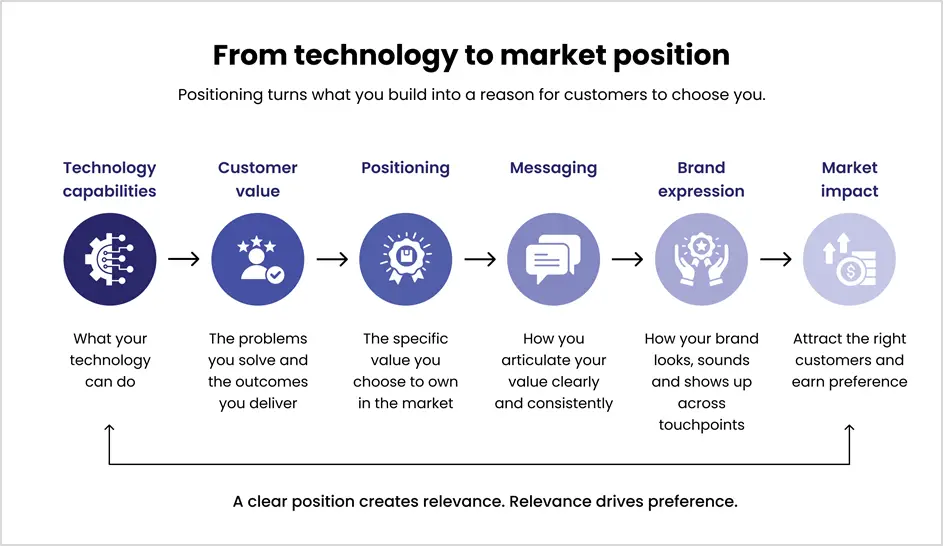
For a B2B tech brand, positioning is what connects technical capability to a reason for customers to choose you.
Where Repositioning Comes In
Sometimes, the technology has moved ahead of the brand.
A company may have evolved from a single product into a broader technology platform. It may have added AI, automation, analytics, integrations, or new solution areas. It may also be selling to a different set of decision-makers than it did a few years ago. Yet its website, messaging, and brand identity may still describe the business as it once was.
TSL helps close that gap.
We look at what the technology does today, where the business wants to grow, and how the market currently sees the brand. From there, we sharpen the B2B tech product positioning, build a messaging architecture around the strongest value propositions, and align the visual and verbal identity to reflect the business today.
The goal is simple: make the technology easier to understand, the value easier to recognize, and the brand more relevant to the customers it wants to reach.
Building a Message Around Business Value
Technical capabilities alone rarely tell the complete story. A strong technology brand also needs to communicate the problems it understands and the outcomes it can influence.
This becomes even more important when the proposition involves complex technologies, multiple capabilities, or technical solutions that are difficult to explain simply.
TSL helps bring structure to what the brand says and how it communicates. The core proposition focuses on the business problems the company is equipped to solve.
Audience-specific messaging then makes that proposition relevant to different decision-makers, industries, and use cases.
The narrative is supported by evidence. Client testimonials, success stories, business impact, and industry-relevant use cases demonstrate what the brand has delivered.
This creates a stronger and more credible brand presence. The company communicates more than its technology or services.
It communicates why its expertise matters to a particular business and why it deserves consideration as a long-term partner.
Making the Position Visible Across Every Touchpoint
A strong position creates value when customers encounter it consistently across the places where they discover and evaluate a brand.
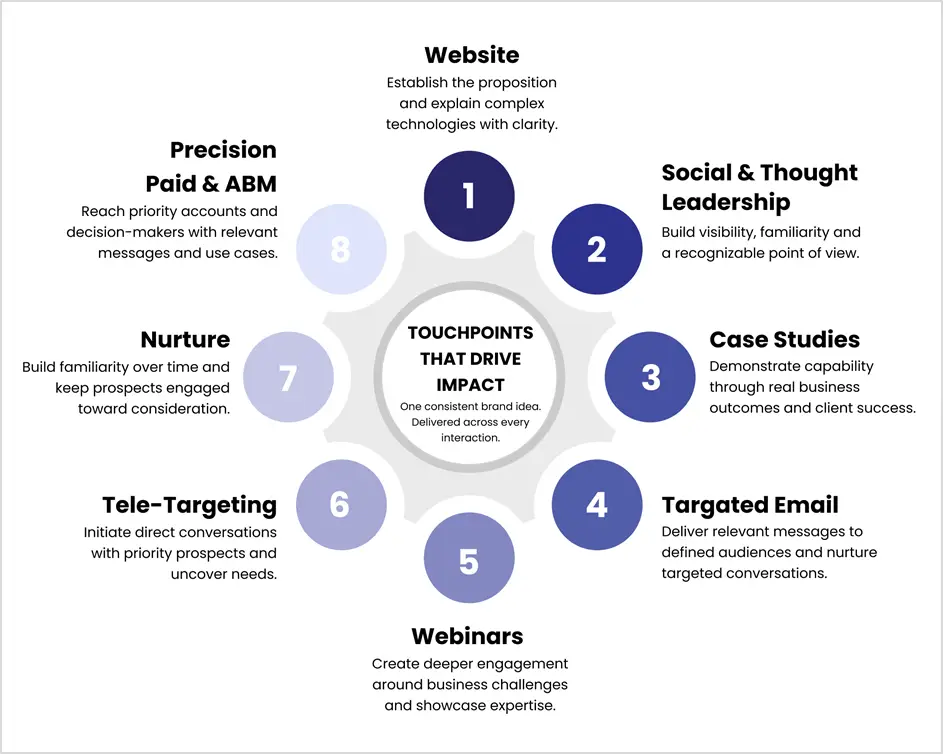
TSL translates the brand narrative into a connected communication system. Each channel adapts the message while retaining the core proposition.
This can include a sharper narrative across the website and social channels, along with targeted emails built around specific audience needs.
Thought leadership can establish a clear point of view. Webinars can create opportunities to demonstrate expertise and engage prospects around relevant business challenges.
Tele-targeting can turn targeted messaging into direct conversations, while nurture programs build familiarity and keep prospects engaged through longer buying cycles.
For priority accounts, the same positioning can inform precision paid campaigns and account-based marketing. These campaigns put relevant messages and use cases in front of specific organizations and decision-makers.
Each channel has a different role. The website establishes the proposition. Social and thought leadership build familiarity and credibility. Case studies demonstrate capability through real business outcomes.
Email develops targeted conversations. Webinars deepen engagement. Tele-targeting creates direct conversations, while nurture keeps the relationship moving.
Precision campaigns bring the differentiated message to specific accounts.
Where Strategy Meets Market Impact
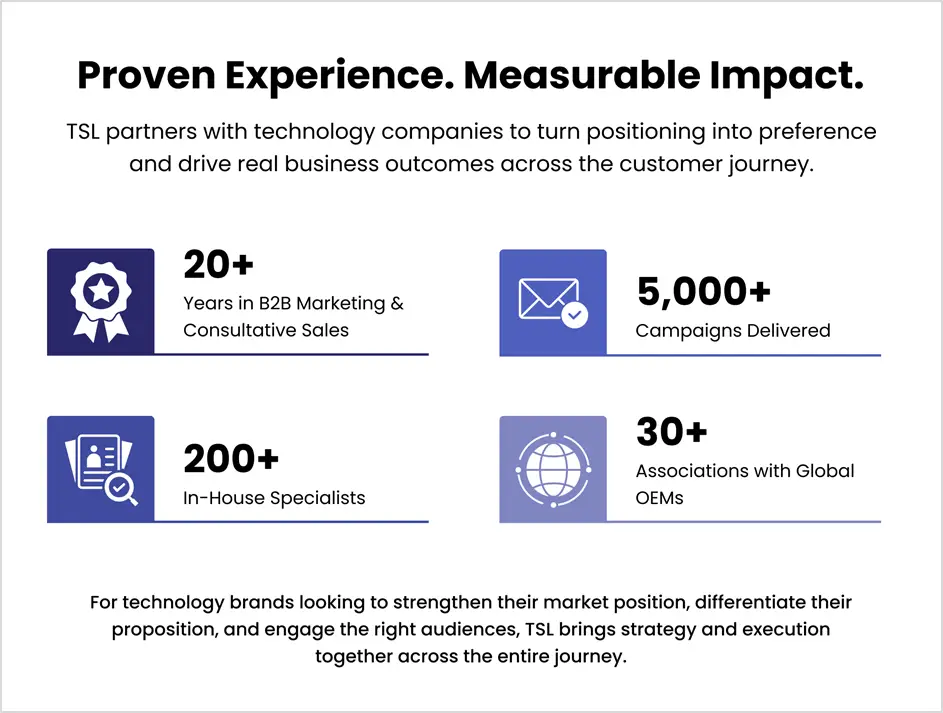
The right B2B tech product positioning can change how a technology brand is perceived, considered, and chosen. TSL brings the strategy, identity, messaging, and market engagement together to help technology brands create that shift.
For conversations around technology brand positioning and market differentiation:
📞 +91 9529286060
📧 smohite@tslmarketing.com